
Will AI Replace the Hair Transplant Surgeon? What AI Hair Transplant Planning Actually Changes
Hair transplant surgery · Technology
Patients are starting to ask this question in consultations. Here's the honest answer — and what AI hair transplant planning means for how procedures get designed from now on.

"Could an AI just plan my whole transplant?" It's a question more patients are asking out loud — half curious, half testing whether their surgeon has an honest answer. The honest answer isn't no.
It's also not yes. It's something more useful than either.
AI is reshaping how every surgical field plans procedures — from orthopaedic implants to dental reconstruction. Hair transplantation, and AI hair transplant planning specifically, is no exception.
Patients read about it, see it mentioned in clinic marketing, and increasingly walk into consultations wanting to know where the human ends and the algorithm begins.
Clinics that can't answer that question clearly lose credibility in exactly the moment they need it most. So let's answer it properly.
Why AI Hair Transplant Planning Is Suddenly Everywhere
It isn't surprising that patients are asking. Hair loss is one of the most heavily researched topics online, and AI is one of the most heavily discussed technologies of the decade. The two were always going to intersect in a consultation room eventually.
But the question patients are really asking isn't about AI specifically. It's about trust. They want to know whether the plan for their own head — their own donor area, their own hairline, their own future — is being built on something more reliable than a chairside estimate.

What AI and 3D Planning Do Not Do
Let's be direct about the limits, because honesty here is what actually builds trust.
No software decides whether a patient is a good surgical candidate. No algorithm evaluates scalp laxity, donor hair quality under the microscope, or how a patient's skin will heal.
No 3D model accounts for the thousands of micro-judgments a surgeon makes during extraction and implantation — the angle of a single graft, the adjustment made mid-procedure when reality doesn't quite match the plan.
These are clinical judgments. They belong to the surgeon, and they always will.
"The best surgeons aren't threatened by precision tools. They're the first to adopt them — because clinical judgment and exact measurement were never actually in competition."
What AI Hair Transplant Planning Actually Does
Here's where the real value sits — and it's substantial.
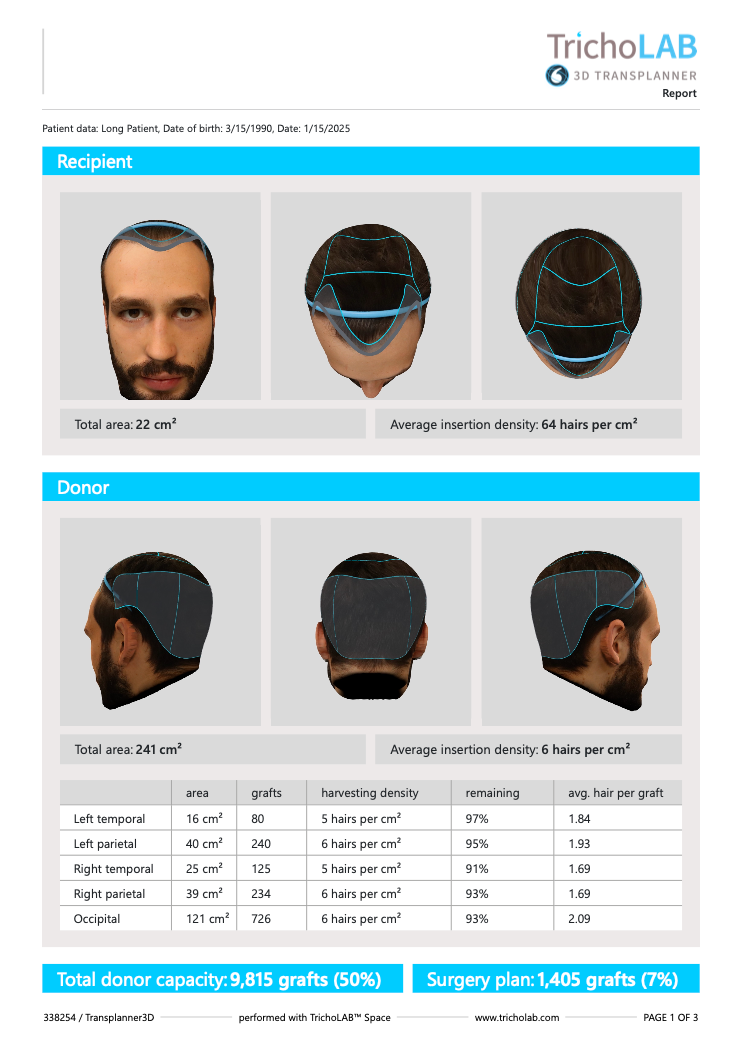
Maps the entire scalp in three dimensions, replacing flat 2D photographs that can't capture curvature, density variation, or the true shape of the donor area
Calculates a precise graft estimate based on actual measured density and available donor surface area — not a visual approximation
Simulates hairline design and graft distribution across the full scalp, so the surgeon and patient can review the strategy before a single incision is made
Generates a realistic visualisation of the expected outcome, giving the patient something concrete to evaluate instead of a verbal description
None of this replaces the surgeon's eye or hands. What it replaces is guesswork in the parts of planning that genuinely benefit from precise measurement — the parts where two experienced surgeons, working from photographs and instinct alone, can reasonably disagree by a thousand grafts or more.

The Real Problem AI Hair Transplant Planning Solves: Inconsistent Estimates Between Clinics
Patients researching hair transplants quickly run into a frustrating pattern. They consult three clinics. They get three different graft estimates. One surgeon recommends 2,500 grafts. Another suggests 4,000. A third proposes a different hairline shape entirely.
From the outside, this looks like inconsistency — or worse, like upselling. In reality, it's usually the predictable result of planning done by eye, from static photographs, without standardised measurement of density or donor capacity.
Traditional estimate: "Based on what I'm seeing, I'd estimate somewhere around 3,000 to 3,500 grafts."
3D-planned estimate: "Donor density is 78 units/cm² across a mapped area of 92cm² — supporting 3,180 grafts with density preserved."
A 3D-based planning process doesn't eliminate the surgeon's judgment about the final number. It gives that judgment a precise, measured starting point — which is exactly where the biggest inconsistencies between clinics tend to originate.
What This Changes for the Patient
For the person sitting across the desk, the shift is significant. Instead of being asked to trust a verbal estimate, they get to see their own scalp mapped, their own donor area measured, and a visual simulation of where their hairline and density will land.
That changes the nature of consent. A patient who has seen a 3D plan isn't hoping the outcome will look a certain way — they've already reviewed it, asked questions about it, and understood the reasoning behind it. Expectations set this way are far more likely to match the surgical result, which is good for the patient and good for the clinic's outcomes data.
Common Questions Patients Ask About AI Hair Transplant Planning
Does 3D planning make the surgery more expensive? It changes how a clinic plans the procedure, not the surgical technique itself. Many clinics treat it as a standard part of a thorough consultation rather than a separate cost.
Can the surgeon still adjust the plan during surgery? Yes. The 3D plan is a precise starting point, not a script the surgeon is locked into. Clinical judgment in the room still governs the final result.
Is this the same as the AI hairline design filters seen on social media? No. Consumer filters apply a generic template to a photo. Clinical AI hair transplant planning measures the patient's actual scalp and donor area and builds a plan specific to their anatomy.
The Future Is Precision Plus Judgment, Not One Replacing the Other
The honest answer to "will AI replace my surgeon" is the same answer surgery has been giving for decades whenever a new imaging or measurement technology arrives: no, but it changes what a good plan looks like.
The clinics defining the next era of hair restoration aren't choosing between human expertise and AI hair transplant planning technology. They're combining both — and showing patients exactly how that combination works, in numbers and visuals a patient can actually evaluate.
That, ultimately, is what patients are really asking for when they bring up AI in a consultation. Not a robot surgeon. Just proof that the plan for their own head is built on something more solid than an educated guess.
Want to see how AI-assisted 3D planning could work in your own clinic?
Message us on WhatsApp — we'll walk you through it.


Comments