
The Rise of Data-Driven Hair Restoration

Updated: Jun 12
How objective measurements are transforming consultations, building patient trust, and defining the next generation of hair restoration clinics.
Imagine visiting three different clinics for the same concern. You receive three different diagnoses, two different treatment plans, and graft estimates ranging from 2,500 to 4,000. All from qualified, experienced doctors. How do you decide who to trust?
This scenario plays out every day in hair restoration clinics around the world. And it points to a structural problem that has defined the industry for decades: too much subjectivity, not enough data.
That is changing fast. A new generation of clinics is replacing impression-based consultations with objective, standardised, reproducible measurements. And the clinics making this shift aren't just delivering better medicine - they're building stronger businesses. Watch below how our Leviacam clinical trichoscope measures hair and follicle:
Why Clinical Experience Alone Is No Longer Enough in Data-Driven Hair Restoration
For decades, the hair restoration consultation followed a familiar pattern. A patient comes in, the doctor examines the scalp, estimates the degree of hair loss, evaluates the donor area, and recommends a treatment plan. The process relied almost entirely on the practitioner's expertise.
That model worked reasonably well. But today's patient is fundamentally different.
Modern patients research clinics online, compare results shared by other patients, join forums like Reddit, watch procedure videos on YouTube, and often consult multiple specialists before committing. They don't just want a recommendation - they need to understand it.
One thing is certain: in today's world, data can explain more than 100 words. Your patients want to see numbers. They want measurements. They want evidence that the advice they're receiving is based on objective facts - not one doctor's interpretation. And when two clinics give contradictory guidance, they have no framework to evaluate who is right.
This is where the traditional model breaks down, and where data-driven medicine steps in.

The Technologies Making Objective Hair Restoration Assessment Possible
The tools to close this gap now exist - and they're accessible. Digital trichoscopy in particular has transformed what clinics can measure, document, and communicate during a consultation.
What modern trichoscopy reveals:
Hair density and follicular unit density per cm²
Hair shaft thickness and miniaturisation levels
Hair growth progression over time
Scalp condition and health indicators
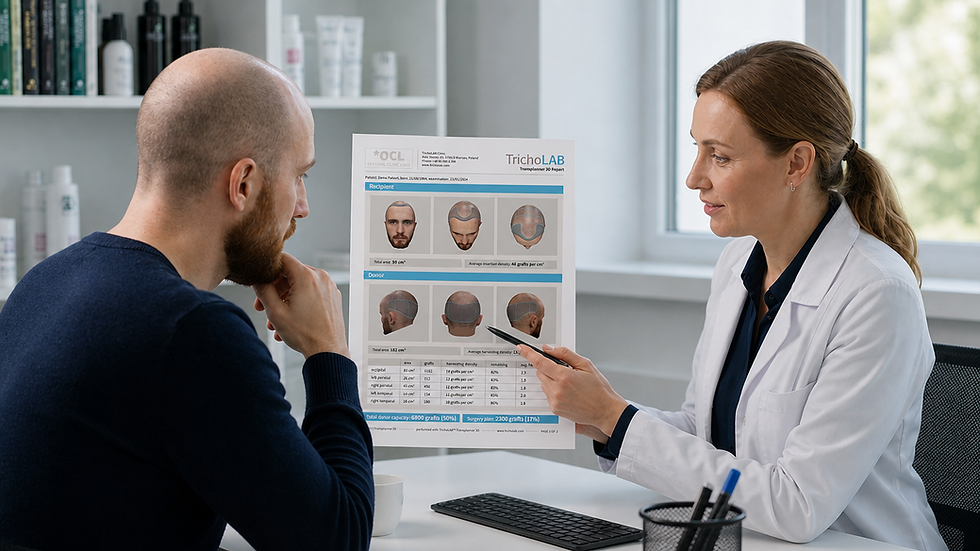
Instead of a verbal impression, the patient sees their own scalp data on screen. Instead of "your hair is thinning in this area," the consultation becomes: "follicular density in the crown is 50 units/cm², compared to 68 in the safe donor zone. Here's what that means for your treatment options."
AI-assisted analysis is adding another layer - helping clinicians identify patterns and organise data more efficiently than manual review alone. And 3D imaging is transforming surgical planning, giving both doctor and patient a clearer picture of donor resources, graft requirements, and realistic long-term outcomes.
"The consultation process shifts from a subjective conversation into an educational experience - one where the patient becomes an active participant in their own treatment."

How Data-Driven Hair Restoration Monitoring Solves the Compliance Problem
Better consultations are only part of the story. The deeper value of data-driven hair restoration emerges over time - in how treatment progress is monitored, communicated, and used to drive compliance.
Hair loss treatments require patience. Whether a patient is using finasteride, minoxidil, PRP, exosomes, or a combination, meaningful results may take months to become visible. And human perception is surprisingly unreliable at detecting slow, gradual change.
This creates one of the most costly problems in the field: patients who stop treatment early - not because it isn't working, but because they can't see it working.
Why Patients Abandon Treatment?
Most patients who abandon treatment do so before measurable results are visible - simply because progress feels invisible.
The pattern is well-documented. A patient begins a treatment protocol with genuine commitment. They return for the first follow-up, sometimes the second. But somewhere between month two and month four, motivation erodes. Not because the treatment is failing - in many cases, it is working - but because the patient cannot perceive the change. Daily self-examination in the mirror is an unreliable instrument. Hair grows slowly. Density improvements occur in increments that are imperceptible from visit to visit without objective measurement.
What follows is a predictable cognitive shift: if I can't see it, it must not be happening. The absence of visible evidence becomes, in the patient's mind, evidence of absence. And once that belief takes hold, the cost-benefit calculation changes. The treatment becomes an expense without a return.
There is also an emotional dimension that clinical literature often underestimates. Hair loss carries significant psychological weight. Patients who invest in treatment - financially and emotionally - are particularly vulnerable to disappointment when their expectations of visible progress outpace the biological reality of the treatment timeline. Without a clinical framework to manage those expectations, the consultation relationship deteriorates quietly, and the patient simply stops showing up.
The result is a compliance gap that costs clinics far more than the lost appointment. A patient who abandons treatment early rarely returns. They don't refer. And in an era of online reviews and peer-to-peer recommendations, their unresolved experience becomes part of the public narrative around your clinic.
How Objective Monitoring Changes That?
Standardised longitudinal monitoring shows patients a clear, data-backed picture of their progress at every follow-up - even when that progress is subtle. By returning to the very same scalp coordinates each visit and collecting measurements under consistent conditions, clinics eliminate the guesswork.
The downstream effects are significant: higher compliance, better long-term outcomes, and patients who feel genuinely informed and involved in their own care.
Data-Driven Hair Restoration Is a Stronger Business, Not Just Better Medicine
The case for data-driven hair restoration isn't purely clinical. It's a compelling business proposition.
In a market where patients consult three to five clinics before choosing one, differentiation is everything. A consultation that presents standardised measurements, documented baselines, and a clear monitoring plan signals something no marketing campaign can manufacture: genuine clinical rigour.
Patients perceive higher professionalism and trust the diagnosis more readily
Compliance improves, which improves long-term outcomes and word-of-mouth
Documented records protect the clinic against disputes and unrealistic expectations
Retained patients require less acquisition spend - the most efficient growth lever available
Retention, not acquisition, is the real competitive advantage in a maturing market. And nothing drives retention like a patient who can see, in their own data, that what you're doing is working.
The Future of Hair Restoration Belongs to Clinics That Combine Expertise with Data
No software replaces the judgment, artistic vision, and medical expertise of a skilled hair restoration specialist. That will never change.
But the future of the field will belong to clinics that bring both: human expertise grounded in objective evidence.
Patients today want more than promises. They want transparency, measurable benchmarks, and confidence that their treatment is working. Data-driven hair restoration provides the framework to deliver exactly that.
The era of evidence-based hair restoration has already begun. For clinics committed to the highest standard of patient care, adopting it isn't just a clinical choice - it's the foundation of trust itself.
Want to see what a data-driven consultation looks like in practice?


Comments